
|
The option for aluminium
The hull of a MC 41 SK is turned over Being a metallurgist engineer I like metal boats, which is natural. That does not mean that other materials are unsuitable or inferior, just that aluminium is my material of choice, and the following text shows why. The first favourable feature of aluminium is the fact that it is a metal, as steel, and sometimes the obvious must be stated to reinforce a good point.(The word aluminium here is used to mean aluminium alloys, not the pure metal, which has not much use as structural material – steel is also an iron carbon alloy, not a pure metal). As a metal, aluminium has all those properties that make metals the materials of choice for most structural applications in the world, apart from very specific applications in niche industries such as aerospace and competition vehicles. To calculate the structural behaviour of an aluminium part or any metal part is a straightforward process because metals are isotropic and homogeneous in mass, meaning that their mechanical properties are not direction dependent and that a portion of aluminium has the same properties of every other portion of the same composition. Aluminium alloys used in the marine industry are also not susceptible to ageing, which means that their properties remain stable with time.
The energy absorbed before fracture is proportional to the area under the stress strain curve Another good characteristic of metals is that they deform elastically when a stress is applied and, when the stress surpasses a certain limit called the proof stress, they will acquire a permanent deformation, called plastic deformation, and will absorb an energy proportional to the area under the stress strain curve shown here. This deformation absorbs energy from a possible impact and is a safety factor as well as an early warning for failure. Seeing the good features of metals that make them good structural materials, aluminium alloys enjoy a good position in the marine industry since the 1950s, after the 5000 series alloys (aluminium magnesium alloys) were perfected, due to their unique features, as follows:
HSV Aliso carries 500 passengers, 148 cars and 112 coaches at 37 knots From these features the most important to our analysis are the first two. Designing two structures, one in aluminium and the other in steel, to have the same rigidity, the aluminium structure will weigh only 50% of the steel one. Or, saying it in another way, if we have two vessels weighing the same, we can have the aluminium one extremely stronger built. This weight advantage is not limited to the comparison with steel. For the same strength aluminium boats are also lighter than Fibre Glass Reinforced Plastic boats. Before the appearance of the modern cutting edge laminates with Kevlar and carbon fibres, aluminium boats dominated the scene in offshore racing, remembering the famous Eric Tabarly and his various aluminium Pen Duick boats. These cutting edge materials are many times very expensive and their production processes beyond the reach of small builders, and their longevity can be smaller than aluminium. Aluminium’s corrosion resistance in the marine environment (Alloys 5083, 5086 and 5383 are virtually inert in salt water) means a long service life and good re-sale value. The production costs are also lowered because the material does not need any surface treatment other than priming and anti-fouling below the water line. Boats and other coastal structures like piers made from aluminium alloys have been in service for several decades, being sometimes replaced because their designs became obsolete rather than because of any degradation due to corrosion. Among most common materials used today for boat building, aluminium is the only one that will keep its properties if exposed to salt water without any barrier. You could even drill a hole and expose it to salt water in a boat, and no degradation would occur to the drilled aluminium (of course the boat would sink if the hole was under the waterline, so no great gain here!)
A magnificent aluminium boat, Amyr Klink´s Paratii I The net result of all this is more stable and faster boats due to better weight distribution, with few limitations to hull shape because of the good formability of the material, with good productivity when building because of the light weight and good welding speeds. Aluminium affords safe and durable boats, features we all seek when building or buying. Luis Manuel Pinho is a metallurgist engineer graduated in 1990 by Rio de Janeiro State Federal University, and a lifelong sailor and twice amateur boat builder. He lives on board boats with his wife Marli Werner since 1996, having sailed in excess of 30000 nautical miles, mostly in the Pacific and Atlantic Oceans. He collaborates with B&G Yacht design in some designs, producing CNC cutting files for our metal boat designs and doing some design work of his own creation. |
|||||||||||||||||||||||||||||
| Building the dinghy Caravela 1.7
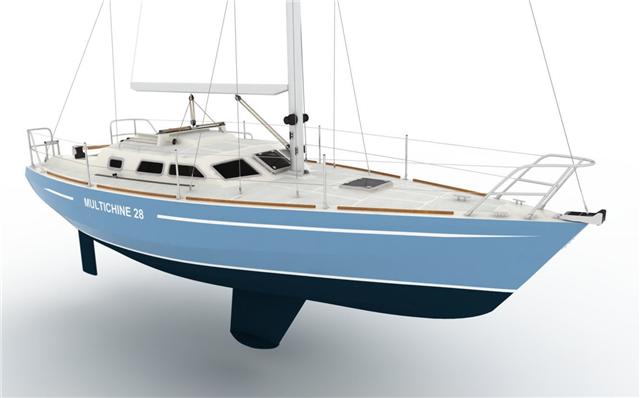
The dinghy Caravela 1.7 was custom designed to serve as tender for our Multichine 28 cruising sailboat project. Since this boat has an unobstructed flush foredeck, we were consulted by many of our clients about the possibility of carrying a solid dinghy on it. So we felt it was a nice idea to provide a plan for building a dinghy tailored to fit in that place, leaving enough room for the crew to circulate around it without feeling cramped. As the dinghy is included in the Multichine 28 stock plan package, we had the idea of offering it for free to anyone who wanted to build her.
The dinghy Caravela 1.7 was custom designed to fit the Multichine
28 foredeck. That was a good decision we took, even though for different reasons than those we had foreseen. Many amateurs who want to build a boat for the first time wish to try first building something easier, and the Caravela 1.7 is just perfect for the purpose. Besides, the Caravela 1.7 is an extremely versatile, unsinkable tender, capable of being propelled by sail, outboard motor, or simply rowed. Already being available as free plans for a few years in our site, we have been informed that there are Caravelas 1.7 being used as leisure dinghies or tenders in the oddest places, like Siberia or Antarctica. The plans have been used in boat-building and sailing schools, some of them running with non-governmental organization funds, something that lightened our hearts to be informed about. The folklore about the Caravela 1.7 is endless. One day we were watching an adventure video about a Norwegian who was sailing in Antarctica waters. When approaching a scientific base in a calm day in one of the many havens in that continent, his engine stopped functioning, and he promptly deployed his dinghy, which was no other than a home-made Caravela 1.7, to tow the sailboat to the base’s pier. On another occasion a Caravela 1.7 was stowed vertically next to the foreface of a sailboat mast with a halyard lashed on the lanyard pad eye when a fierce gust of wind made the dinghy take off the deck and, after swinging in a long arch, land on the spreader of the sailboat in front, at the other side of the pier, about some five metres above deck level. And the stories are so many that one day we will have enough material to write a book…however, up to now, most of them are related with newcomers to the sport of sailing who never built a boat before. Once in a while we receive such enthusiastic e-mails, some of them showing nice photos of their dinghies being built or already sailing, that makes us believe this has been a great achievement in the lives of their builders.
If you built or are building a Caravela 1.7 and want to send us an e-mail to info@yachtdesign.com.au, we will be delighted to know your story. Click here to open the Download Page of the Caravela 1.7 |
|||||||||||||||||||||||||||||
| Singapore, our temporary address You might be intrigued why B & G Yacht Design (formerly Roberto Barros Yacht Design) is temporarily operating from Singapore, instead of Perth, now its permanent address. Our office is a family business. The founders, Roberto Barros, and his British wife, Eileen, founded the company in 1987 at the city of Rio de Janeiro. In 1991 their daughter Astrid Barros, and her just married husband, the naval architect Luis Gouveia, joined the office, where they worked until May, 2007, when, willing to spread the scope of the office’s market, decided to shift the business to Perth, where they grew deep roots and are permanently established now, buying a house there and opening the B & G Yacht Design branch of the company (B & G from Barros and Gouveia). The original Roberto Barros Yacht Design office didn’t close its doors, and is still operating in Rio de Janeiro, with the assistance of Eileen and Roberto.
Luis, Astrid and kids having dinner out in Singapore Things made a radical change in March 2009, when thanks to Astrid’s PhD degree in fluid dynamics, she was invited to be the project engineer for the construction of the first drilling rig built to exploit the gigantic ‘pre-salt’ oil field recently discovered about one hundred miles offshore Rio de Janeiro. Since presently you can operate from anywhere provided you are linked to the web, the family packed their bags, and there they went to Singapore, where this first drilling rig was starting its construction. This oil-rig, the Gold Star, is already concluded and this November will leave Singapore bound for Rio by way of Cape of Good Hope, calling at Port Louis, Mauritius, for refuelling and shifting crews.
The drilling rig Gold Star ready to leave Singapore bound for Rio de Janeiro It happens, however, that another rig has been ordered to the same shipyard by the company she is working for, and Astrid has been invited to stay in the job until the delivery of this second rig. The change of address was good for a change, since Singapore is a civilised place with superb quality of living, while Luis and Astrid’s kids are frequenting Australian schools, with no interruption in their way of life. The new address allowed the family touring in their holidays to interesting places nearby, like Bali, Malaysia, and now with an intended trip to Borneo.
Astrid, the lady boss as the Chinese engineers call her, is the one in blue overall The yacht designing activity is carried out by Luis Gouveia, with Astrid’s eventual help, when she is not too tired, since yacht design runs in her blood. Luis is also assisted by the staff that remained in Brazil. Being one the best known Brazilian yacht design offices, it is no wonder that most of our boats are from Brazil, but this is changing rapidly, since our more recent builders are mostly from the Northern Hemisphere. We feel a great pleasure in understanding that the cruising ‘tribe’ is universal and that there are no boundaries dividing oceans, and what really matters is being aboard sound boats with pleasing lines to warm the heart.
The digital clock in the fly-bridge displays the names of the staff responsible for the construction of the Gold Star |
|||||||||||||||||||||||||||||
| South Pacific Cyclone Seasons aboard Green Nomad A major threat to any cruising plans is the tropical revolving storms that occur in most tropical regions during summer. These are called hurricanes in the North Atlantic Ocean and cyclones in the South Pacific. Strictly speaking, a tropical revolving storm is called a cyclone if the sustained wind speeds it generates are equal or above 64 knots. Since the areas in which we like to cruise are mainly situated in a belt of 25 degrees to each side of the equator, well in advance of summer for the hemisphere in which we are cruising we have to decide how to avoid or cope with the upcoming cyclone season if we are in an affected area, such as the South Pacific Ocean.
During the years we cruised in the South Pacific aboard Green Nomad we opted for many different ways to cope with the cyclone season. In the first season we sailed all the way from Panama to Australia, where we arrived in Brisbane, which is South of the normal limit for tropical cyclones, so we were out of danger. After we spent three years in Australia working and becoming new Australians, we decided it was time for another Pacific Journey, since the first one had been by far too fast. This time we had to go against the trades to reach island groups to the east of Australia. Being so hard to get back to the islands, we decided that going down South again to an area outside the tropics, which basically meant Australia or New Zealand, was not interesting, and so we decided that we would spend the next few cyclone seasons around the tropics, but we would have our cyclone season plans always ready well in advance. Basically one can choose three kinds of evasive action regarding the cyclone season: 1 – Finding a region outside the tropics, where tropical cyclones do not form. It is the preferred option of most cruisers in the Pacific, but it entails longer trips at the end of the cruising season, and normally having to cross areas that are traditionally boisterous, as the passage to New Zealand or even the approach to the Australian coast near Brisbane. It also means getting back to a more urban lifestyle, in marinas, or at least anchored off big towns. 2 – Looking for a suitable place near the equator, generally less than 8 degrees in latitude, N. or S.. It is perhaps the safest option, but it still requires a lengthy passage. The upside is that you gain a whole new cruising season, and by norm you end up in idyllic places, which have been little affected by the madness of the modern world, apart from most of them being earmarked for sinking slowly into the ocean due to sea level rises forecast to happen as the earth climate changes. 3 – Staying in a cyclone affected area, but in a place that you know to have good hiding spots, the so called “cyclone holes”.
A world to oneself in the South Pacific anchorages during the cyclone season. When the first summer was coming we decided that we would stay in New Caledonia (thus choosing n° 3 option listed above), a place we had fallen in love with and that we were not willing to leave behind.
In order to decide our course of action we needed to make sure there were really safe cyclone holes in New Caledonia and try to get from locals and other cruisers precise directions on how to get into them. Having no insurance for the boat meant that all our material possessions were at stake, not mentioning the risk of getting hurt, or even worst. New Caledonia is an overseas territory of France, and it is made up of a main island called the “Grande Terre” and many smaller ones, such as the Isle of Pines and the Loyalty Islands. The Grande Terre is surrounded by a coral barrier reef, and in its southeast end is located the Isle of Pines, where we spent most of our cruising days before the cyclone season. The Isle of Pines (Kunie in the local Kanak language) truly is one of the wonders of the world. We have to try very hard to remember another place that comes close in beauty, quality of anchorages, marine life and water clarity, and so on. So, when the cyclone season was approaching, we started our way back to Noumea with a broken hearth, but getting closer to the cyclone hole we had chosen.
Masthead view of Isle of Pines. Amongst many possible options, we had decided in favour of a mangrove system near a bay called Port Laguerre. Port Laguerre is located about 10 Nautical miles NW of Noumea, the capital of New Caledonia, which in itself is already a well protected anchorage, but not a cyclone hole, as many would be reminded later in that season.
Chart of the South of New Caledonia, showing Port Laguerre ( 1 ) and the Isle of Pines (2) As you can see from the chart the way from Isle of Pines to Port Laguerre is far from clear of dangers, and the 70 nm cannot be safely made in one day by small cruising sailboats if there is any kind of adverse weather. Daylight navigation should be the norm there if one prefers to stay in the safe side of things. Taking that in account we decided to spend the cyclone season months, from December to May, anchored in between Noumea and Baie Saint Vincent, some fifteen nautical miles away from Port Laguerre.
A panoramic assembly of Noumea’s port, with Port Moselle marina in the foreground and the anchorage to the left.
Green Nomad, a solitary in Baíe Saint Vincent, April 2003. As usual, we had supplies to last for six months, and just fresh produce and fish were needed to complement our stocks, so, most of the time during cyclone season we spent in anchorages not too far from Port Laguerre, the main one being Baie Papaye (red anchor sign on the chart below). From there we could do trekking in the surrounding mountains, go fishing on the nearby reefs, scavenge the beaches for edible shells, pick fruits in the bush, and relaxing at night under a breathtaking sky, outlining the ragged mountains.
Baie Papaye anchorage and the track to the mangrove cyclone hol
Green Nomad at anchor in Baíe Papaye We had an old notebook and used our SSB radio to pick up weather-fax signals from the Australian, New Zealand and USCG weather services. In between 1200 and 0200 PM most of the useful charts were transmitted, and our daily routine included analyzing them while we had our lunch. In this way we had almost a week forewarning for any cyclonic activity. In particular the Pacific Streamline Analysis transmitted by the Honolulu weather-fax station would clearly show at least a week in advance if something was brewing. Of course you would only get that feeling after repeated observation. By the end of December 2002 we decided to do an in depth check of the cyclone hole, and, with a hand drawn map we had copied from another cruiser, we got into the dinghy taking a handheld GPS and a sounding line (a diving belt weight tied to a rope with knots at every half metre) with us, and followed the indicated track, taking soundings and registering waypoints, producing a local chart of sorts. That was a must since there was only a very narrow channel, and contrary to the norm in this area, the water colour did not give you any clues for the depth when seen from sea level.
Hand drawn map of the mangrove cyclone hole
Notice the shallows in the way to the mangrove hiding hole! This picture was taken with the polarized sun glasses in front of the camera lenses.
Mountain top view of the cyclone hole As if to reward us from all that work, on December 28th, 2002, the weather maps were showing cyclone Zoe, with wind speed of up to 180 knots, passing over the small island of Tikopia, and moving straight to New Caledonia. We spent the last days of the year anchored inside Port Laguerre bay together with some other boats, one of them the Brazilian catamaran Saravá. Lots of partying and some worrying, but in the end on that occasion we did not move into the mangroves. By the end of January the time had come for the first real test of our cyclone hole. Cyclone Beni was aiming at New Caledonia, and together with two other boats, one of them belonging to an Australian couple, and the other to a Swedish single-hander, we moved into the mangroves. It was not a light decision to take, since considering shallowness of the channel, and our 1.78m draught, we had to wait for high tide to move in, and this had to be a daylight high tide, so we eventually were not granted a chance to draw back during those five, six days before the cyclone, besides the whole affair of tying up being very tiresome. The mosquitoes were also a constant company, should we get stuck in there for a fortnight. At least on the bright side there were no salt water crocodiles such as the ones we would have to deal with later in Australia, where we did not know which was worse, a cyclone catching us out of the mangroves or a crocodile getting us inside them!
Tied up with friends waiting for cyclone Beni
Boats are ready, so we may as well get together and do some cruiser style dinner party with Juergen, from Sea Tramp and Peter and Sandy, aboard Otama Song Beni”s track passed 30 Nm south of Noumea and all we felt in Port Laguerre was 35 knot gusts and lots of rain. But we did not waste our time training for the big one. In March cyclone Erica formed near the Australian coast and started strengthening and to move in a big arc passing near the Solomon Islands and pointing again to New Caledonia.
Cyclone Erica’s track, which reached category 5 at some stages . As one cannot always be lucky, that was one of the rare periods we had moved away from Baie Papaye, and when Erica showed up on the maps we were in Baie Saint Vincent, 15 Nm to windward of our safe haven, and it was blowing 20 to 25 knots. A heavy boat ( 13 tons ) and a small engine ( 30 HP ), besides having to deal with the narrow channel, it was the time for full throttle, and 3 knots of boat speed being all we could get. This time we got into the mangroves five days in advance. And believe it or not, right up to the last morning before the cyclone hit, we were the only boat there. We almost made half turn and left in the same tide we went in, as the New Zealand 72 hour forecast showed Erica weakening and bearing away. But look at the satellite picture we downloaded 3 years later in Australia. Erica was a huge cyclone, nearly as big as the main island of New Caledonia, which is 254 nautical miles long. Centre pressure was down to 920 hPa, and sustained wind speeds were 150 knots, reaching 190 knots in gusts.
Cyclone Érica, a monster with a well formed eye. Notice the outline of the main island of New Caledonia to the SE of the cyclone. Preparation was to tie the boat to ten different points in the mangrove trees, each line being passed through as many roots as we could reach, remove all loose items from deck, store the sails down below (mainsail was left out, well tied around the boom), remove solar panels and wind generator blades, go up the mast and remove the Windex and tri-colour light, and the list goes on. The evening before the cyclone was expected saw us ready and able to
give a hand to other boats that would come. Most of them had draught
problems as we did, and had to wait for high tide to get in. And the
last tide window was to be at 03:00AM.
But in fact nobody else tried to get in, apart from our other friend, Maho, on a small aluminium catamaran, which got in before Edi, as he could move at any time due to its shallow draught. Some did not get in by sheer impossibility, like Jean Michel and Zaza from Kyrymba, a seventeen metres long steel goellete. Jean Michel and Zaza were in their third circumnavigation, having even been cruising companions of legendary Bernard Moitessier. Some did not believe it was needed; some were lazy to go to all the trouble. The anchorage of Port Laguerre, the bay right outside the mangroves, had some 5 boats anchored, which had decided that it was safe enough already to be there. Saravá, the Brazilian catamaran, was inside the mangroves, but in the main channel, as her huge beam did not allow her to access the side channel like we did, which was safer by being narrower, deeper and out of a possible strong current.
Saravá could not reach the side channel due to her wide beam, while Kyrymba stayed just outside the mangroves because of its excessive draught. Both were quick to act, but their boats limited their chances of protection. Having the boat ready, all we had to do now was to wait and monitor the cyclone’s track. The local VHF radio broadcasted regular updates and we also were receiving the usual weather maps. So the boat was ready but, what about us? We knew what we had to do and had done it as well as possible, but up to that moment we had no idea of what the weather in a cyclone would look like. We had been at sea in 50 knots of wind, but 150, that was beyond common experience to even start imagining. In the early hours of the day the cyclone was to arrive, a fine rain started, and it did not stop and became heavier and heavier as the cyclone approached. The radio updates told us that Erica was now moving at 20 knots, which is very fast for such a big cyclone. We would later conclude that this quick motion was a great helper, as it limited the time the cyclone affected a given area. A lot of damage was suffered by the boats and other property in Noumea, but if the cyclone had been moving at the more usual speed of 6 to 10 knots, we believe that New Caledonia’s nautical scene would have been wiped out almost entirely.
Boat tied to the mangroves but lots of work to be done yet, such as removing solar panels, wind generator blades, storing loose items below decks…
You couldn’t see Green Nomad from outside the lateral channel. Ahead of the eye the winds from Erica were blowing out of the NE. As the cyclone was moving in a SE track, the winds were a bit weaker that the real cyclone wind speed, since they were composed with the cyclone movement, and also high mountains provided some protection from that quadrant. So, the first half of the experience was a bit milder than expected. The wind speed increased during all morning, and at 1100 AM we estimate they were blowing around 70 knots, but as the refuge was worth its name, at water level there was no real concern inside the mangroves.
These pictures were taken before and during the passage of the cyclone’s eye. As the eye passed overhead we were even calm enough to snap this picture using the camera’s timer. As the cyclone’s eye moved overhead the wind started to decrease, and I even was confident to get out on deck and check things, making sure all lines were secure. During the first half of the cyclone passage I was mostly perched on the companionway ladder and peaking through the dodger’s tempered glass windows. Marli was looking through the side portlights, and I thought that the framing around the bookshelves would show her fingernail prints by now. We sat in the cockpit waiting for the eye to pass and for the real blow to start. Our warning was a darkening of the sky followed by a strong roar. Our friend Edi thought the ordeal was over and was on his dinghy on the way to Maho’s catamaran when the strong south-westerly started, but luckily he was close to the boat and got there in safety. I got down but still managed to see through the dodger. I was looking at the treetops when something amazing happened: All of a sudden most leaves left them in concert, as if ordered. The wind noise was terrifying and we were heeling 30 degrees only by the pressure on the top third of the mast.
The barometer had long ago been rendered useless, and the pointer rushed past the scale’s bottom well before the eye reached us. This stronger second half of the storm only lasted about half an hour, with varying intensity. But opposite to the wind speeds before the eye reached us, which increased slowly from 20 to maybe 70 knots, the wind speed dropped quite drastically after this half hour. We did not have an anemometer on Green Nomad, but the official wind speeds recorded in Noumea were around 110 knots. As soon as the wind abated we got out on deck, and all was in order. The whole deck was covered in thorn leaves and the water level had raised a lot, and its colour changed from the usual green to a light brown.
The water level was much higher after the cyclone passage. Notice the two spools we carried to store 100m of 20mm line on each deck side. Very handy for demanding anchoring situations. Our first thought was to go and check how the others had done. We got into the dinghy and went out of the mangrove lateral channel. To shortcut a long story, apart from Kyrymba, which was nearly inside the mangrove, all the boats that decided to stay anchored in the access bay had found another element below their keels.
Of all anchored boats none stayed in the water, all were high and dry with varying damage, apart from a racing catamaran, around 28ft long, which allowed herself to face the cyclone in style by taking off but forgetting to land with the keel down, losing the rig in the process. Sarava, the 55 ft catamaran that was inside the main mangrove arm was unscathed, but her skipper, Cacalo, told us that the roots to which he was tied broke one by one, and in the end there was only one line holding them. We remained in Port Laguerre for five days more, getting the boat back together again (solar panels had to go back up, wind gen, and so on) and helping on the effort to get the grounded boats back into the water. With Kyrymba using her powerful engine and all dinghies pulling from the top of the masts with a halyard to help to turn the boats in the right direction and reduce draught by heeling, we managed to refloat all of them. In those five days a lot had been done to clear Noumea’s port from the damage, but when we went back there, what we saw were lots of masts sticking out of the water and an impressive amount of floating debris. On our way to Noumea we had an incredible sight: the southwest side of the hills was brown, as the leaves had been burnt by the friction of the salt water spray caused by the strong SW winds. As far high as 30 or 40 metres above sea level!
Lots if debris and boats tossed about on the streets of Noumea!
The first and only stainless steel boat we saw! The sights on the local repair yard and hardstand were no less dramatic.
Could you picture a steel boat hull looking like this?
Erica was not fussy about hull materials. She dished it out on all! We still spent another three months in New Caledonia, and in June resumed our voyage, sailing to the island of Tanna, in Southern Vanuatu, after a quick stop in Lifou, in the Loyalty Islands. We were relieved to be out of the cyclone season. Or almost, as on June 6th, after a couple of relaxed days not looking at any weather maps, we decided it was time for a check, and sure enough, cyclone Gina was bearing down on us, already in the island of Espiritu Santo, Northern Vanuatu! That was a big fright, since Tanna did not offer any all weather anchorage, never mentioning cyclonic conditions. So, if Gina really was going to come over us, the only thing to do was to put out all anchor gear and get out of the boat onto high ground. Heading to another island was out of the question, as our speed would be insufficient to get us anywhere safely. But Gina decided to be kind and started to veer and weaken. But it left the message that early June may be too early for lowering your guard.
2003-2003 season South Pacific cyclone tracks For the next cyclone season we decided that we did not want the company of Ginas, Ericas, neither their boyfriends, so we headed for the Kiribati Islands, in the Gilbert group, which are all located within 3 degrees of the equator. No cyclones there and we would have one of the most memorable experiences of our cruising life, meeting some of the kindest people on Earth. After that season, the next one we spent in the Solomon Islands, which lie mostly between 5 and 8 degrees of latitude South, and therefore are also out of the danger zone.
Zazen ( BRA), Green Nomad (BRA), Nyathi ( USA) e Joceba ( FRA) in the Solomon Islands. Sleepy morning after an enjoyable night party! With these choices we managed to spend three years without having to leave the island groups of the Pacific and accumulated some of the best moments of our lives, living a natural and peaceful existence (ok, discounting nail marks on the shelving, malaria and...) But we had to get back to Australia and work again, go to Brazil to see the families and plan on future voyages. As we elected to stay in Cairns, which is located in the Northern Queensland coast, we were back on a cyclone affected area, and so weather maps and cyclone warnings were the order of the day again. And should we have forgotten our cyclone handling skills, cyclone Larry, one of the most destructive in Australian history, would remind us, since it passed just at scant 30 nautical miles south of us, shattering a whole village totally to the ground. We had got licences from our jobs in order to be prepared for the cyclone season, and also because it rains almost all the time there in those months (February, March, April). We did a bit of sounding just like in New Caledonia, so when the big one came we had a plan.
Tying the boat to the mangrove roots in Cairns, Australia. Every time a branch moved I only thought of a crocodile’s big mouth closing!
Green Nomad getting ready for cyclone Larry This time I missed Port Laguerre, where the only problem was the cyclone, because during the months we stayed anchored in Trinity Inlet, in Cairns, many times we saw salt water crocodiles swimming past the boat. So, any thing brown that moved quickly became a crocodile in our minds, and getting down on the dinghy to tie ropes to the mangroves was not done with a light hearth. Te locals told us to make lots of noise, hit the water with the oars when approaching the mangroves, so the crocs would move away frightened. If they got frightened we don’t know, but us…
Second cyclone cat. 5. Many lines to stow, but no damage! Luis Manuel Pinho, luisdesenhos@gmail.com is a member of our yacht design staff and presently is building his new Green Nomad. This time he chose the Kiribati 36, the latest B & G stock plan, mostly designed by him. As soon as the boat, which is being built in Porto Alegre, South Brazil, is concluded, he intends, together with his wife, Marli Werner, to return to the South Pacific, this time feeling more prepared to face awkward situations during the hurricane season, thanks to the swing keel system adopted in the design of the new boat. |
|||||||||||||||||||||||||||||
Green Nomad in Kiribati
In November 2003 we were in Vanuatu, Banks Islands, which have been named after the botanist Joseph Banks, a member of the Captain Cook’s Endeavour expedition. It was time to seek shelter from the South Pacific cyclone season.
The options included either to go north and stay close to the equator
line or pass to the northern hemisphere, or to go south, outside the
tropics, which meant Australia or New Zealand, or stay another season
in the cyclone area in some place where good cyclone holes could be
found.
We started the passage
with pretty strong south-easterlies, the famous Trade Winds from the
southern hemisphere blowing their last breaths for that year. We had
to sail with two reefs in the main and staysail, with a fifty to sixty
degrees apparent wind angle. The wind started to ease after three days,
and, as we would expect, we started to enter the area of variable winds,
calms and thunderstorms that are characteristic of the passage between
hemispheres.
We arrived there with an overheating problem in our engine, so we had
to cross the pass under sail, having to tack a few times along that
narrow channel, which it is not an easy task and is even less welcome
after eleven days at sea. However, once inside the lagoon we could use
the engine for the last three miles that separated us from the anchorage. The immigration chief at the time had making peoples’ lives difficult
for sport, but we ended up with all papers we needed and a permission
to stop by in Abaiang and Butaritari on our way to the Marshall Islands.
These twenty-five miles of water separated two worlds. Away from Tarawa
one can witness the Micronesian way of life like their forefathers lived
for ages.
We stayed in Kiribati for five months, four of them during our first
passage, and another on our way back south, after spending another five
months in the Marshall Islands, which lie a few hundred miles north-northwest
of Kiribati. Another remarkable feature of the Kiribati culture is the still common use of the traditional Polynesian outrigger sailing canoe. They are in no way inferior to any modern catamaran (and cost a lot less to build). I was constantly running to Green Nomad’s foredeck to get sailing magazine quality pictures of these fine sailing craft. They soon discovered I liked to photograph them sailing, and would present me with many a close pass. And yet another memorable moment was being invited to fish with our
friend Teinabo and his brother.
We left Abaiang with a heavy hearth, but soon we would find ourselves
surrounded by new friends in Butaritari, the northernmost atoll in the
Gilbert group.
Being anchored in one of these atolls always provided for images that defied your imagination. In Abemama, where the Scottish writer Robert Louis Stevenson lived, the blue would stick around even if the weather would try otherwise.
Kiribati was so special to us that we feel we have to go back one day. Apart from being in an oceanic paradise, it was evident that their sustainable lifestyle is a viable one. People looked to live happier than their modern consumer society counterparts, and knew how to use their environment to survive, while respecting it. As the memories that this people and place left in us are always driving
us forward to go back there, we are building a boat again, after selling
Green Nomad in Australia in 2005.
Also we got rid of the submarine ride feeling, as traditional sailboat
design made us feel. The new boat has panoramic view from inside the
cabin, due to the 9 hatches surrounding the main cabin area. |
|||||||||||||||||||||||||||||
A new revolution in auxiliary propulsion for sail boats
It is interesting to notice that it required many decades more to ban the complexity of masts, rigging and sails from commercial navigation, leaving the art of sailing for cruising and racing yachts alone. During the twentieth century, when combustion engines became common place in all sorts of vehicles, it didn’t take long for those expensive and noisy villains to invade the bilges of our sailing boats. Following the trend in yacht design during the last decades of the nineteenth century and first ones of the twentieth, hulls had pinched stern overhangs and long keels with rudders joined to them, requiring an aperture between keels and rudders for propeller installation. Those crafts were slow, had poor steering control and were difficult to build. Then the plastic revolution came into scene and sail boats began to receive fin-keels, which considerably improved their performance when sailing close hauled and rudders were separated from fins, improving their efficiency. Later on a third improvement was introduced, which was the widening of the after quarters of sailing boats, up to the point that some modern designs have the maximum beam practically at the transom. This type of shape with flattish after lines and wide transoms increased speed when running or reaching, improved dynamic stability, besides proportioning more symmetrical waterlines when the lee topsides were submerged This trend in yacht design, however, required a correction for steering efficiency, due to the loss of rudder performance, as the boat heeled. The solution was to adopt twin inclined rudders. This dramatically enhanced steering control in all conditions. When running, the two blades providing dual control and when heeled, if the windward blade got partially out of the water, the other one assumed an almost perfect position, close to plumb line, right in the centre of the groove. In spite of some loss of simplicity, it seems that large transoms and twin rudders came to stay in sail boat design. Meanwhile a new silent (literally) revolution is taking place; the introduction of electric motors for sail boat auxiliary propulsion. It’s amazing that such an obvious solution took so long to be accepted. Of course it wasn’t an easy proposition to let salesmen proclaim that a little gear resembling a car alternator could substitute the bulky brutes, with their thousands of parts, many of them movable. At any rate, the new idea had all to do with the spirit of sailing; a quiet motor that doesn’t pollute, the energy it consumes being stored when the boat is under sail, the very motor then becoming its own generatorJ, not mentioning that solar panels and wind gensets, two ecologically friendly equipments, would also contribute for energy’s supply. It was no surprise that some beautiful pieces of equipment began to appear in bilges of many sail boats and presently we already are beginning to hear people saying that they will never install a combustion engine in their future boats, what seems to be a hard blow for combustion marine engine manufacturers in the near future. We have a rewarding satisfaction as yacht designers; no matter how small is our contribution, to participate in the new trends of our trade. It is exactly the case with this issue concerning electric motors. We were sold to the idea at the first moment and we are already beginning to specify this propulsion in our latest projects. However we are foreseeing other possibilities that can represent a great improvement in cruising speed, steering control and safety: the use of twin electrical motors in front of two rudders in sail boat hulls. With this configuration the boat can motor-sail whenever the energy equation is favourable, keeping hull speed when sailing in lighter winds, without having to worry about poor carter lubrification of engine parts due to excessive angle of heel. When running with banks in a low stage of charge, it’s just enough to resume to sailing and putting the engines in charge mode. This is the closest one can go towards freedom of energy consumption. On the other hand, when quietly motor-sailing, or just motoring, rudders will hardly require any effort to steer, since the accelerated flux of water in their leading edges will be contributing to their efficiency. Perhaps, when programs of the type that dump rolling in vessels, or even those supplied in auto-pilots, which adjust their speed to the state of the sea, it will be possible to steer exclusively with the two engines, changing the revs in one of them as required, to keep a straight course. Of course this is just an exercise in futurology. More obvious still will be the manoeuvrability of boats with this sort of propulsion. They will turn in their axis as if they were running bow-thrusters. Large oil rigs already use electric thrusters for their locomotion and even to keep them in a stationary position, so why not apply this very same technology in a much simpler way, installing electric motors in sail boats? Roberto Barros Yacht Design, www.yachtdesign.com.br is already specifying electric auxiliary propulsion in its trailerable sail boat design, Pantanal 25. |
|||||||||||||||||||||||||||||
| Maitairoa in the Falklands We sighted Jason Islands, a small archipelago north of the Falklands,
three days after leaving Mar del Plata, our last port of call. Aboard,
missing less than one hundred miles to arrive, our mouths were already
watering with the expected tomorrow's lunch in the best restaurant in
Port Stanley. But it was written in the stars that it wouldn't be so. Maitairoa is a very sturdy and stable yacht, and whenever she faces
bad weather, her crew feels as though being confronted with a simple
breeze. Perhaps for that reason I didn't take the necessary precaution
of keeping the boat sufficiently offshore. To crown it all, our engine
wasn't functioning and our depth finder, fouled by barnacles on the
transducer, was recording inaccurately. Suddenly, out of the mist, where
there should have only been open sea, a hill loomed ahead preceded by
breakers. Foreseeing imminent danger, I tried sailing close-hauled to
escape the trap into which we were falling, but to no avail, since only
then did I perceive that there was a strong current throwing us southwards
in the direction of the Falklands channel. It didn't take long to hear
the thundering noise of our keel colliding with hard ground. We had
just been snared.
We dropped our Bruce anchor with about twenty metres of chain plus
a good length of a half inch nylon warp, trying to keep the boat in
that position. But our hopes didn't last more than a few minutes. After
a couple of breakers raising the boat like a rearing colt, the nylon
rope parted as if it was a string. When convinced that nothing would
stop the boat from drifting ashore, I asked the crew to hold on firmly
and let the seas do the job of beaching her. The discomfort lessened
considerably after winning the first line of breakers, even though the
boat heeled dangerously from side to side. We threw our kedge with just
a short length of chain, to oblige the boat to point the stern towards
the breakers, this way diminishing the impact against our topsides.
|
|||||||||||||||||||||||||||||
| PLY- GLASS VERSUS SANDWICH OF STRIP PLANKING Our line of Multichine ply-glass sailboats are a series
of plans we have designed for amateurs which permit people without previous
experience to build cruising sailboats capable of navigating on high
seas with comfort and safety. This method of construction is simple
to execute and practically all those who decided to build one of these
boats, following the instructions of the construction manual, have been
able to accomplish the work without difficulties. |
|||||||||||||||||||||||||||||
Custom Designs Our office designed the motor yacht Sea Baron 57 for one of the leading glassfibre processors in Latin America, Hidroplas S.A., a company installed at the city of Botucatu, state of São Paulo, Brazil. Planned to be constructed in foam sandwich, for lightness, strength and speed, this boat could be included in a category of yachts five or ten feet larger. The reason for this is an after owners cabin with bathroom en suite, leaving this area isolated from the traffic of people aboard, a feature seldom found in the fifty foot range of motor yachts, without a raised sheer line at after quarters. Our team developed the design with the collaboration in structural dimensions and propulsion of Jorge Nasseh and Marco Antonio Vieira, two experts in these fields of technology. As a result the plans of the Sea Baron 57 are among the most complete and sophisticated designs of luxury motor yachts to be found anywhere. arti |
|||||||||||||||||||||||||||||