
Building manual Technical data History Characteristics Order Form Photos Keel Hull Construction Deck Hardware Rigging Sail Plan List of Plans Dimensions Layout Description

Fiu's Log Book n° 27

The preparation for our intended return trip to the South Pacific is reaching its final stages. Some of those less obvious preparation tasks, the ones which many potential cruisers, including ourselves in the roll, often neglect, are being concluded.

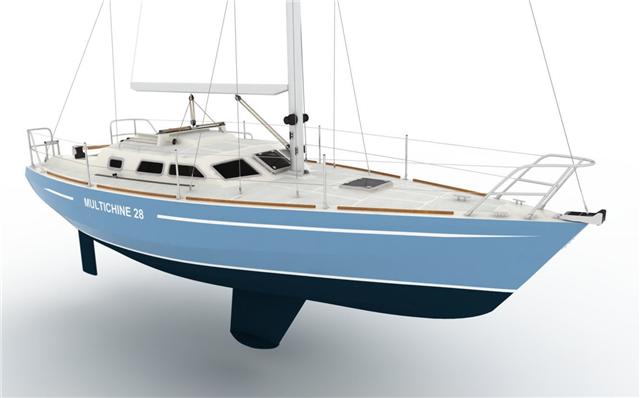
Actually our boat since its conception as a project and through its construction and first years of usage has always been prepared for long distance cruises. It seems to be obvious now, but the choice of the MC28 design was the most important decision we made. We could have opted for a larger monohull, or perhaps a central cabin cat, but we chose instead the MC28 stock plan, which was developed as if it was a custom design for our requirements.

Our decision to build the MC28 was based on a cost/benefit analysis. She was the smallest boat to provide the range and comfort necessary for a couple in an ocean crossing, with the option of having another couple as crew, and by the other hand she was the largest boat we could afford to build. We have seen too often people trying to make a larger boat than their pockets allow. In most cases when the constructions are concluded, they are broken and can't afford buying the essential expensive equipment to conclude their boats. This is a bad mistake, since not even resale value these boats possess.

When Fiu was concluded Eileen and I went to live aboard. We lived on her for two consecutive years. During this time we continuously improved her, buying new equipment and doing things to improve her seaworthiness. We made six thousand miles of coastal cruising just as sea trials. Now we feel we have done our homework and we are ready to leave.

We intend to be sailing next August or September, with stopovers in the Caribbean, Panamá and a few islands in the Pacific. For our bad luck we haven't much time to spare, since we need to start working the sooner possible at the other side of the world.

We hope to be in New Zealand sometime next year, leaving the office activities to our partner Luis, which will be done from Perth, Western Australia. Meanwhile if any of our many builders of other MC28 under construction or already sailing, or any other builder of a boat from our design want to contact us, we ask to address us by way of our personal e-mail, robertobarros@hotmail.com. If professional information is required, please contact info@yachtdesign.com.br, or by the phone number: 61 08 9339 8236, and Luis will answer you. He will stay there permanently from now on.

Fiu’s logbook n° 26

It’s quite exciting to disassemble the tent after staying in the same campsite for a very long time. After twenty years of uninterrupted work at the same address in Rio de Janeiro, Luis Gouveia and Astrid Barros, two of the four partners of the family business Roberto Barros Yacht Design, decided to change street, city and country address, traveling to Perth, Western Australia, where they arrived on May fourteen, while Eileen and I are preparing our MC 28 Fiu for a cruise via Panama Canal to New Zealand first, and then Australia.

Luis and Astrid arrived in Perth after a three days long trip with stopovers in Santiago, Auckland and Sidney, and in a fortnight they rented a house, bought a car and installed a fixed telephone, which steps already qualified them with the status of authentic residents.

Meanwhile Eileen and I are doing the necessary preparation for our cruise. We used to joke with our friends who are intending to go cruising in one of the boats designed by us, that we worked hard to assist them in making their dreams come true, when what we really wished was to do it ourselves. But now it seems that our turn has come. We feel like two beginners, so great is our enthusiasm when we tick any item of the extensive list of tasks of the preparation for the trip.

The MC 28 was built with the intention of using her as a blue water sailing yacht capable of performing ocean crossings in comfort and safety. Her intrinsic robustness, large fuel and fresh water tank capacity are some of her positive features for the purpose.

Designing the MC 28 was like detailing the funnel of an hour-glass. We provided her with the best ideas we employed in previous plans, those many things that only experience teaches.

When the design was concluded, I decided to build one of these boats, and invited a friend, Roberto Ceppas, to join me in the construction of two sister-ships. It’s amazing for the home builder how efficient it is to build in group, especially when one of the builders participated in the elaboration of the project. The two boats produced, Makay and Fiu, became references in the class, since solutions had to be found for every single detail of the construction. Taking advantage of the opportunity, we took notes of the whole process and produced a building manual describing step by step all phases of the construction. This was an important achievement for our office. Since then, all our new projects profited in some way with the learning involved in the construction of these two boats. When the firsts MC 28 were launched, including Makay and Fiu, the prestige of the class reached the amateur community of boat builders in many countries, and the class never stopped to spread internationally.

My wife Eileen and I intended to accomplish long voyages with Fiu, the most ambitious plan being to circumnavigate the globe from West to East. This trip for many reasons ended up never happening, but even so Fiu performed some mid distance cruises, with about six thousand miles already sailed on her. Fiu sailed from Rio de Janeiro to Santos and twice to the Northeast of Brazil, always showing a seaworthiness more easily found in much larger boats, and her performance under sail was also very impressive for a 28 footer, with some daily runs surpassing the one hundred fifty miles mark.

We considered these tests as a success and now we feel we are prepared to go. Since there are many other MC 28 builders getting ready to leave also, we are wiling to exchange experiences with them, and for this matter we may be contacted by means of e-mail info@yachtdesign.com.br


Multichine 28 Vagamundo, a good example of amateur construction.

The Multichine 28 Vagamundo built in Vitoria, a city 300 miles north of Rio de Janeiro, by the deep water diver Ricardo Campos Costa is becoming an authentic work of art. Ricardo built his boat almost unassisted taking full advantage of his long spells off required by his trade, and now that his boat is practically finished, he intends to live aboard and begin a long distance cruise.

Ricardo's effort is a good example for those who dream with a life of sea adventures. In spite of not having any previous experience in boat building, the quality of his work surpasses by far the average standard of series production yachts, and he spent peanuts compared to current prices of boats of the same size.

Meanwhile we received excellent photos of the MC 28 Ayty when she was launched.. His owner Arapoan Fernandes was very inspired when he produced the paint layout of his hull and the next pics of this boat we intend to publish will for sure be his boat sailing under full canvas.

Click on images

* Multichine 28 Vagamundo

Click on images

* Multichine 28 Ayty


FIU'S LOG BOOK Nº25

We don't need to go far to appreciate special happenings just at beer tin throwing distance from Fiu's stern. As our boat is at the moment being prepared for the next trip, all we can do for the time being is to watch from our cockpit the events that are taking place around us, like the departure of the Volvo Ocean Racers, leaving for the Baltimore leg. They passed so close to Fiu's transom that their crews could listen to our farewells

Click on images

Once the great event was over, we resumed our own affairs, like the improvements we made in our Caravela 1.7 Pinta, the tender that we carry aboard our Multichine 28.
As we offer this design as free plans in Internet, it's a reason for satisfaction to know that she sails beautifully, and that she offers good amusement when our boat is anchored in places where sailing the dinghy is an interesting past-time exploring the surroundings.
I don't know how the lives of other yacht designers are, but in our case, the rule is an incredible amount of work to be accomplished and absolute lack of time left for us. That's the only explanation we find to explain long time we took to complete our final tests with the Caravela.
In our search to find a cheap solution for her mast, I tried out, almost one year ago, a 1" PVC tube to be dressed by our sleeve-type sail. The result was quite unsatisfactory since it bent too much, not allowing the dinghy to sail properly. Now I found the time to install an internal pipe tube that fitted perfectly inside the other one, resulting in an ideal solution for that issue. The mast obtained bends just the right amount to flatten the sail when the wind increases, costing us peanuts, besides being light and durable. With this problem solved, I went sailing inside the protected waters of Marina da Glória.
I had no idea how fun it was to sail her, especially for me who never sailed a boat that small. She sails to windward with competence, and is very stable. However my most important discovery, was to know that she doesn't require a sheet to trim the sail. Like a windsurf board, it's enough one hand holding the boom, with the other left for the tiller and to rise and lower the lee boards. Now it's my intention to invite the many other builders in our region for an informal race, promoting a great party with a racing rally included.

Click on images

That same day, my wife Eileen and I were just storing back our Caravela 1.7 on Fiu's fore deck, when we were called by our daughter Astrid and her husband, Luis. They arrived from Rio Yacht Club, the same club frequented by the Olympic champion Torben Grael, the skipper of V.O.R. Brasil I. They had just finished crossing the bay from Niterói to Rio de Janeiro, to show us the stitch and glue 16 foot Andorinha (Swallow) they had just rigged for the first trial.
Even inside the calm waters of the Marina, where the wind is light or inexistent, they showed impressive bursts of acceleration unmatched by the other classes that happened to be sailing at that moment.
They had come with their two children, the twelve years old Christian, and the little Juliana, just two years old. Christian was holding the tiller, while Juliana was having great fun watching the dinghy sailing. When they lashed their boat to a finger close to ours, our neighbours came to see what boat was that sailing so fast in such light winds.
Leaving Juliana with us, they went sailing more racing-like, comparing their speed with other one-designs which were also crossing the bay.
As we have various Andorinhas being built here and in other countries in Europe, we expect that people will start to develop a special taste for the class, and that it will keep growing in numbers in different regions.

Click on images

FIU NEWSLETTER NO 23


In 1998 the book From Rio do Polynesia, a best seller of the kind during the eighties, was edited for the third time.
When this edition was being prepared I was finishing the construction of our Multichine 28 "Fiu", built with the intention of returning to the South Pacific in a trip of remembrances. For various reasons this voyage had to be postponed and the work at our design office stole the time Eileen and I were intending to spend in this new adventure.
However we used our boat "Fiu" as often as we could, and presently she has already six thousand miles of ocean passages, in unforgettable long distance cruises.
Finally, after seven years, it seems that new opportunities are appearing, so that our dreamed return trip can take place, and to help us in keeping the hopes alive, we are publishing in our site the introduction for the 1998 edition.
To those interested in the book, we are looking for a publisher for the English edition, and when the book will be edited, we will inform in our home page.

FOREWORDS FOR THE 1998 EDITION

It is as if we had left the cabin and entered the cockpit, and in a flash we could see all the scenery that was left behind.
Imprinted in our memories, as an unforgettable movie picture, it would flourish the remembrances of all the good and bad moments shared together, the many mysteries unveiled, the sensation of overtaking important stages in our lives.
Those were the days when rebellious youth wished to be rid of a Vietnam on each corner. We were a generation of easy riders and weren't even conscious of that. The dictatorships financed by the terrible cold war were imposing their standards of conduct and submission, and, on the other side, the youths contradicting with an anticulture, preaching peace, love and freedom.
It was a time when the problems of our Earth were not as serious as they are now, and if the powerful were not so paltry, they could easily be diminished, for there were even resources to travel to the moon.
Many Indians from the Amazon could still dodge his white brother, who desired their lands. They still hadn't succumbed completely to the tutelage of the white man's authority and weren't dependent on the support of pop stars for their claims.
Disillusioned Europeans could find islands in the Pacific where they could resort to a simple existence, undisturbed by the outside world. The Brazilian coast was visited by so few cruising boats that national and foreign yachtsmen arriving in any of its ports were considered heroes.
The two of us, young and restless, could not accept the impositions of the establishment. We didn't want to choose sides. And how we were right! It was as if we were by ourselves in believing that both sides of the orange were rotten.
Brazil, you have to love it or leave it, was the propaganda motto of the military dictatorship.
We will leave, of course. What would our family think of us? They will think we are mad. Who knows if some will envy us?
What did we expect from the future? It can only get worse. Why not go then? Wait for what? To become rich and only then look for simplicity? It doesn't make sense.
Brazilian composer Caetano Veloso's ''Alegria, Alegria'', calling people to discard oppression, was the hit at that moment. ''I'm going with nothing in the pockets or in my hands''…were the words of the song that so deeply impressed us.
We were advised to write a letter to the director of the Department of Income Tax, informing him that we would be travelling taking with us just a few miserable dollars and that we intended to work along the way. A friend of ours, who was an important person in the Ministry of Finances, delivered in hands this ridiculous statement.
Bossa Nova was then becoming popular all over the world. We were going to hear it frequently, in night- clubs, on the radio, everywhere.
In Ipanema "village" we were acquainted with almost everyone. The icons of Bossa Nova, Tom Jobin, Vinícius de Morais, Carlos Lira, Menescal, were nearly our neighbours. But what really touched us was hearing their music being played on the drums of the Calypso steel bands at the furthermost of places.
Preparing the boat for departure sometimes seemed to us an interminable task. When we started to doubt if we were ever going to sever the navel cord, we suddenly found ourselves sailing on the high seas, hearing the cadence of waves hitting the topsides of our hull and seeing the bow pointing towards our dreamed endeavours.
And we almost found what we were looking for. It's true that at each place where we arrived there were the local owners. Canal Zone, Mururoa... But there was still plenty of space. It felt as though nobody minded if you were there, as long as you weren't particularly noticed. People were helpful and kind to us. Wherever we arrived we made good friends.

We never felt lonely, even when we were in the great vastness of the Pacific. We shared the place with many friends of different species. Sometimes we ate them, but on the other hand, it wasn't once or twice that we noticed looks of bad intention directed at us. That was the rule of the game, and we accepted it with fair play. We were there because we wanted to be, and we were happy.
Being in the South Pacific was a dream come true. Indolent south-seas songs, turquoise coloured waters, white beaches surrounded by palm trees, bathing in the nude in pristine waterfalls, everything made sense. That was the paradise we were looking for.
But it didn't take long to find new troubles to torment our minds. A licence to stay, another licence to work, the proverbial "jeitinho", the Brazilian way of solving problems. Then our daughter was born, her existence bringing to us new responsibilities. At the other side of the world our parents were calling us back to our homes. The dream was vanishing. Finally the director of the Income Tax Department was the winner. There were no more Beatles, no more hippies, not even the moon was spared for poets and lovers.
Other Brazilian yachts would follow in our trails. Samba, Vagau, and quite a few others. For Willis, the discoverer of Tahiti, even captain Cook, who arrived there just a few years later, didn't find the same Eden. All we can do now is to open the fore hatch and look forwards. The boat isn't new anymore, but she still navigates. What changed was the equipment. In place of the old sextant with its vernier, it's the GPS instead. The old zinc bucket was substituted for a proper toilet. But the content remains the same.
Friends? These will certainly be others. Madeleine, the Tahitian dancer, it's best not to look for her. It would be a pity. At that time there was no video camera to document her charms. Nobody would believe it now.
But there are still the islands we haven't visited. There are more than three hundred thousand of them in the South Pacific alone. If there were only seven or eight, it would suffice.
What is missing then? To return quickly, while there is still time.


OUR REPRESENTATIVE IN ARGENTINA VISITS US

Last December we received a visit from Adrián Callejon, our salesman in Argentina. He was spending his honeymoon in Búzios, a very popular beach resort visited by many Argentinean tourists, one hundred miles distant from Rio.
On his return trip, he and his wife came to visit us at the office, giving us the opportunity to meet them personally for the first time..
On this occasion we took the Callejons aboard our Multichine 28 Fiu, so he could inspect personally a sistership to his "Soñado", the MC 28 he is building in Buenos Aires. During our conversation Adrián informed us that in the meantime he has built a dinghy Caravela 1,7 employing newspaper to sheath the hull. He took part with this dinghy in an informal rally of home built boats of all sorts.
Surprisingly the dinghy supported the weight of the crew and performed beyond expectations.
This experience reminded us of Bernard Moitissier who considered building a cruising boat made of papier machê to cross the Atlantic Ocean After the incident of the Caravela 1.7 that was blown to the spreader of a boat stationed in front, remaining tucked there, and the case of another of these dinghies which towed her mother ship in Antarctica, It's difficult to imagine any other kind of accomplishmen to surprise us. See some captions of the Callejons visit to Fiu and the launching of the Caravella 1.7 during the rally in the River Plate. In time: the Caravela (Portuguese Man of War) was developed to be carried on deck of the Multichine 28, and because of the great interest arisen, we decided to offer it in our site as free plans.
Click on images

FIU NEWSLETTER NO 22

Roberto Barros and Eileen in Recife
During the last month and a half, the MC28 Fiu returned to the open sea, sailing about 3000 miles, most of them single-handed. This was the ultimate test before the conclusion of the construction manuals I'm writing for our most popular stock plans. I'm sure it's comforting for our clients to know that besides designing our boats we are frequently involved with their building, and later we sail them as often as possible. It's like the old Chinese saying: - What I read I forget, what I see I learn and what I do, I know.
This year I decided to repeat the 2003 experience and race the Recife to Fernando de Noronha Island ocean regatta aboard my Multichine 28, taking as crew member my wife Eileen. At this opportunity, we were also commemorating forty years of sea adventures, reminiscing our honey-moon when we sailed from Rio de Janeiro to the city of Santos and back aboard a 16 foot pocket cruising sail boat. Three years later we were the first Brazilians to sail to the South Pacific, aboard the engineless 25 foot Sea Bird, in a three years adventure related in the book From Rio to Polinesia , a nautical best seller in Brazil. Because at that time we didn't care much about sun exposure, not even employing skin filters (I don't know if they existed at that time), Eileen, with her sensitive English skin, developed serious skin problems, and for that reason she decided to join me at Recife, instead of crewing Fiu in the north bound trip. To make things simpler, I sailed single handed my MC28 in a non stop 1200 miles crossing, making an excellent passage, taking ten and a half days to reach Recife. Two days after arrival Eileen joined me, and we shared a lovely time, living aboard Fiu for unforgettable two weeks and having the reminiscences of the former stay at the same Yacht club, 37 years ago. Once Eileen never returned after that first sojourn, it was interesting to hear from her that she didn't recognise anything from the first time, including the club installations, except for the mud banks at the river estuary and the natural reef that makes the breakwater that give name to the city. ( Recife means reefs in Portuguese ). The only acquaintance from that time we met now, assured that except for us , all other friends we made then, aren't alive any more, what we considered a bad omen.
During our stay in Recife, we scheduled a lunch party to join the crews of the ten yachts designed by our office that were participating in the race, and that event took place at the Pernambuco Yacht Club, the other important Yacht club in the town. The commodore of that club, Jaime Costa, is building one of our designs, and had a great sympathy for this event. Once his wife runs the club's restaurant, we were extremely well treated. About sixty persons came to the lunch party, including crews and other friends. After the lunch I gave a commemorative plaque to each skipper with his name and the name of his yacht. The party was a great success, and, the great emotion was to take 30 persons on board a double ended whaler that was supposed to carry ten passengers at most. Those who preferred to go by car were concerned about the ability of the ferry to arrive in safe conditions at the other club. The return trip with full stomachs was less popular, and many opted for more conventional means of transportation.
When the day of the race arrived, we had the boat provisioned for one month, once it was our intention to sail back home straight from the island, and there, supermarket prices are much more expensive than in the continent.
When we heard the gun for our class to start the race, the winds were almost non existent, but as I had promised to Eileen that we were not racing, just joining the fleet, we had the mainsail reefed, and instead of the light genoa, we hoisted a heavy cloth yankee fore sail. Of course, most boats went away and we drifted towards the first mark of the race, a channel buoy, seeing the other classes passing by. Once the wind increased later during the day, we started to progress reasonably well. But, despite all the precautions with Eileen 's skin, she started to feel old problems, so we decided to return to Recife, and enjoy a few more days together instead of insisting in going to Fernando de Noronha islands. We had a very enjoyable sail back to Recife, and once again Fiu's galley produced wonderful meals accompanied by excellent wines. Back to the club basin, now practically empty, we were entertained by our local friends and it was with a sad feeling that I said goodbye to Eileen.
Early next day I hoisted sails and started my trip back to Rio de Janeiro, some 1200 miles south. This passage was uneventful, except for a strong cold front I had to endure, which lasted three merciless days of fifty knots winds in gusts. But after the end of the depression, the Northeast wind returned, strong as usual, and Fiu ran with the jib winged with the whisker pole at steady 8.5 knots for almost a day long. Unfortunately another cold front hit us some 30 miles from our marina. This time I preferred to run the engine and point into the waves, despite the terrible slamming, and reached my finger in the marina in a few hours. The whole trip took eleven and a half days, one day longer than when going North, not so bad considering the heavy front winds I had to cope with.
This test was another demonstration of the seaworthiness of the Multichine 28, and after about 6000 miles in four years of blue water sailing, the boat is sound and safe as when she was launched.


FIU NEWSLETTER NO 19

A huge flying fish for breakfast.
The most important experience obtained in our cruise to Fernando de Noronha was the single handed non stop passage from Recife to Rio de Janeiro. The MC28 class hadn't been submitted to any sort of long distance trip, even so Utopya and Tatuamunha, two MC28 built in Recife had already taken part in races to that island.
Two years ago Utopya sailed about one thousand miles in a cruise from Recife and back to Camamu, a tropical cruising ground of unspoiled beauty. During this trip, which was taken together with two other yachts, one of them sent a mayday informing that the boat was sinking. Despite all efforts applied it was impossible to stop the leak and the boat had to be abandoned. The rescue boat was the MC28 Utopya and when the crew from the sinking yacht came aboard, they were invited for a fresh water shower, later followed by a first class supper.
That the MC28 is a safe and comfortable sailboat, this is unquestionable. But, that the MC28 is an easy boat to be sailed singlehanded in long distance blue water cruises, this still had to be proven. The story that follows is my experience as a solitary navigator in a 1100 miles non-stop trip from the city of Recife to Rio de Janeiro. I woke up early that day. The boat had been provisioned the day before and all I had to do before leaving was to stow the dinghy on deck. This is an easy task. To hoist it, all that's necessary to do is to shackle the halyard to its towing pad eye and to use the halyard winch to lift it. Two cross belts lash securely the tender to the fore deck.
Ready to go, I left the yacht club basin at 08:30 of the 29 September, prepared to be at sea for the next two weeks or so. For me, those 1100 nautical miles I had to cover to reach my port of call was quite a challenge. Actually I had no previous experience. I remember that my feelings were a mixture of excitement and a bit of apprehension. I had no illusions that it's denied to the solitary navigator the right to commit mistakes. Knowing that in ordinary life this is unavoidable, I had to count on luck and prudence in order to prevent any sort of accident. When Fiu crossed the harbour entrance I hoisted main and jib. These sails were going to be used from then on for most of the time. For precaution, despite the lightness of the SE wind I reefed the mainsail for the first night. Later on I would feel more acquainted with my new life style but at least to start with what I really wished was an uneventful first night at sea. Fortunately, except for a few fishing trawlers we experienced no traffic for the first hours. At sunset the wind increased in speed, and all of a sudden I was witnessing Fiu reaching six knots of speed with reefed main.
When night came fishing trawlers started to appear around us bringing some apprehension about the possibility of a collision. . As I was starting to get tired from the long day of sailing, I had to experiment sleeping for the first time in the voyage. Everything in life has its first time, and my first snooze was no exception. I set the alarm clock to wake me up in twenty minutes and got into my cosy bunk. It's amazing how quickly one gets accustomed with the inevitable. In seconds I was fast asleep and when the alarm awoke me, I was involved with gorgeous dreams. The first watch showed a myriad of small fishing vessels that obliged permanent attention, but despite the potential danger of a collision I set the alarm clock for the next half hour and went to sleep again. When the alarm woke me up, and once again there was no collision with the surrounding crafts, confidence started to increase, and from then on my snoozes were much more relaxed. But at every watch some change of course was required, and sometimes I couldn´t go back to sleep straightaway. Once Fiu passed very close to a small trawler, and the helmsman started to shout at us, but our speed was excellent and in no time we were out of reach, at least from his shouts.
The first day´s run was 96 miles, what was not so bad considering the reefed main for such a light breeze. From that day on the boat´s routine came to it's traditional standard and the efficiency was enhanced.
The day before I fed on fruits only, in anticipating future intoxication for lack of green stuff, knowing that in the warm climate, without refrigeration, groceries wouldn't last long. My first hot meal was abominable. Tined tuna with spinach in a tomato and onion sauce. The worse was that I made a bad evaluation of the quantity, so I had to eat the same plate for supper..
This second day brought me awkward sensations. Sometimes I swore that there were other persons on board. When sleeping I imagined somebody else in the cockpit, and when I was outside it seemed like if somebody was inside the cabin. The alarm clock always woke me interrupting beautiful dreams, sometimes with feelings as if my body was levitating. It was a lethargic state of mind where the subconscious prevailed in a pleasant way, what was a good help for my self-confidence. Once in a while I had premonitions that the automatic pilot wanted to warn me of a potential danger, and at these occasions I didn't wait for the alarm to ring. But Fiu kept drifting towards our destination one thousand miles away with a surprising determination. From this day on I felt totally adapted to the life of a singlehander, and I was really enjoying it.
The third day brought an increase in wind strength, but with the firm confidence already established, I didn't shorten sail area. My new challenge was the ship's traffic. We were in the shipping route that intercepted ours diagonally, with most ships coming from starboard. During that day it happened the first small crisis aboard. The main sail cover that is hoisted at both sides by lazy jacks was punctured by the two round battens that stiffen the canvas and those battens started to fal overboard. I had to remove the whole cover and from then on, had no lazy jacks to help bring the mainsail down.
The auto-pilot is the most important crew menber. It took the steering task for more than 3000 miles without complaint. Note the protection cover that kept humidity out of the equipment.

In one of my watches, a huge tanker was at our beam. If they saw us or not I'll never know, but if they came towards us, by then it was time to be listening to the noise of a big bang. That was a good warning. Accidents happen when one gets over confident.
That morning I introduced the routine of eating porridge with dried fruits for breakfast. It's so easy to prepare and so good for the health. Breakfast became an occasion for enjoyment, and became one of the highlights of the adventure. Normally it consisted of toast with butter, jelly, cheeses, biscuits, and fruit juices, besides the referred porridge. At the end of the fourth day's run we had left 400 miles behind us. The weather was fine and the wind was steadily blowing from east, which allowed us to keep a broad reach towards our goal. The ships lane was left behind so there were very little things to worry about. My reading then was quite appropriate for my condition of a solitary navigator. I read about the true story of Robinson Crusoe, the saga of a scotsman Alexander Selkirk who was a castaway on the Island of Juan Fernandes, 600 miles from the Chilean territory..
It was comforting to know that in the long run he was perfectly adapted to his life condition, and after his rescue he had many reasons to miss the times he lived there all by himself. On the fifth day the wind was nearly inexistant. This promised changes in weather. This day I could listen to short waves, what was being denied to me because of interference between the wind generator and my pocket receiver. For the first time since my start I had news from the outside world, and frankly didn't get any more comforted for that. It had been so nice to be an alien in such an intricate amount of world problems. I wish we were sailing towards that island of Robinson Crusoe, some 300 years ago.
My second reading was less inspiring. Rescue in the Pacific. Experimenting such a good weather condition that reading had to bring bad luck to us. So I gave up going ahead with this book and found other ways to amuse myself. If Fiu had to endure all that difficulties I wasn't absolutely sure if we were really well prepared for emergencies of that magnitude. At any rate, this sort of information is recommended for all those who venture deep into blue water, but only before they go to sea. That evening we were caught by the first depression of the trip, and we had to beat against a strong wind, something that hadn't been required before. Fortunately the first blast didn't last long and eventually shifted from south west to south east, not without bringing with it an authentic deluge. I had no option but to dress my foul weather gear and stay at the tiller bar till things settled down a little bit. A ship appeared coming towards us in a collision course. If I wasn't already surveying the horizon, the situation could have been quite dangerous.
The wind increased considerably, requiring a reef in the mainsail. As this wasn't enough to decrease yawing, I was obliged to bring down the jib and kept going with reefed mainsail only. Then, my unassisted manoeuvres were done in a matter of minutes, and I felt almost a telephatic feeling between the boat and myself, as if Fiu was an animated creature.
The oil rigs were in the way when returning from Recife

The challenge I had to cope next was the intense traffic. I called the radio operator from one of the many ships around us to ask if they were catching us as a clear target on their radar screen, what to my relief he informed us positively. I guess that the oversized mast with radar reflector plus the radar tower were an important help.
The sixth day started with a gift from Neptune. A fat flying fish was waiting to be picked up ready for consumption. Fried in butter with potatoes and onions was simply out of this world. After the good news came the bad weather. The wind attained gale force, and the auto-pilot was unable to steer the boat anymore. I was obliged to heave to and wait for better conditions. When I thought the wind had abated somewhat, not to loose time I started the engine and progressed bare poled towards the wind direction. This tactic I didn't insist for to much, not to overheat that precious piece of equipment, but the positive effect on morale of not loosing ground anymore, was instantaneous. Nothing seems to be more frustrating than to see a boat drifting sideways in the direction you are coming from. With engine on, the pilot managed to hold the boat on course and I could rest for a while. But sooner than prudence would recommend I was once more beating under sail. Conditions were terrible and I got very tired that day. That was the worst trial in the whole voyage.
The seventh day brought a northeast breeze and a settled weather. Conditions were so favourable that for the first time I risked setting the alarm clock for a full hour of sleep. Then it seemed that we had left the traffic routes behind, and as fear was decreasing I felt confident to commit such an abuse. The interior of the boat was very tidy and all systems worked perfectly. At that moment I missed nothing and even believed that I would regret when the voyage was ended. That day I considered was the climax of the whole voyage. There were still 300 miles to go but up to then the trip had been successful. I was more than ever accustomed with all sounds that surrounded me. The best of them was the water passing under the hull and the least pleasant could be considered the noise of the mother in law, the nick name of the wind generator, once at full speed it reminds an infuriated rattlesnake. Small objects rolling from side to side were also quite annoying but those were easily found and stopped. But happiness wasn't complete once I missed the company of my family, specially of my recently born grand daughter and my wife Eileen, my companion in all previous adventures. If she was here, sharing this unique experience, maybe I wouldn't even bother in sailing back home.,
Many ships were seen around the boat and at that moment no rest was possible. But there was something positive about the cold fronts that we were experimenting at each odd day. The wind always turned from south west to south east, east and then north east in a few hours. That afternoon I sighted numerous oil rigs to our starboard side. During the night, there were many others to sail by, so I had to watch carefully to avoid a collision.
The ninth day took us to Cabo Frio, already in our backyard. I had some near collision with trawlers trolling shrimp nets. They never changed course no matter if they had the right of way or not, at least for us that were so insignificant, so I had to be over cautious. But by then I felt myself as an authentic solitary navigator and didn't get so easily impressed with these difficulties. Before reaching Cabo Frio I turned the engine on and kept motor sailing till my arrival at Guanabara Bay, Fiu's home. With the engine running I could set the radar full time with alarm for a guard zone and from then on I had very little to be concerned about. The eight of October at half past eight p.m., after nine and a half days of single handed sailing I crossed the entrance of Guanabara Bay, the same time required for the trip in the other way but with the difference that when going north we were three aboard Fiu. That was my ultimate test. Not that a passage in tropical waters single handed is something of great difficulty, but doing it so easily doubtless requires a very special boat, mainly if considering that it's only a 28 footer. Once again Fiu proved itself an exceptionally seaworthy boat, capable of placing extremely well in a regatta where most competitors were racing machines and taking its crew home, with comfort and safety, always behaving in a Bristol fashion. I believe that our builders that chose the MC28 as the boat of their lives will be glad to read this newsletter. For all of you I wish the same luck as Fiu has afforded us up to know.
There are some remarks that I would like to mention that may be useful to other members of the MC28 club..
1 - The most important equipment in my single-handed return trip was the autopilot. An Autohelm 2000 Plus, it was capable to steer the boat in all conditions except when the wind surpassed 40 knots and the seas grew accordingly.
2 - A second fundamental gear was the navigation light at mast top. This light was used during all nights and even if for bad luck another vessel approached Fiu when I was sleeping there was a good chance that they took the initiative to alter course.
3 - With pilot and navigation light on, if the wind generator wasn't working for lack or excess of wind, I lost voltage during the night. This was a drawback once the radar couldn't be kept operating for the whole night. When I reached Cabo Frio and turned the engine on, things became much easier aboard.
4 - All other systems worked perfectly well. We covered 3000 miles over all, and our consumption of fuel didn't reach 60 litres. Fresh water was more impressive still. I arrived in Rio with the tanks nearly full, despite the fact that I just filled them before leaving Recife to Fernando de Noronha. In this aspect, the MC28 is a champion.
5 - Fiu is an incredibly functional yacht. For myself, it seemed I was in a comfortable flat. Cooking, bathing, sleeping everything was performed with ease and comfort.
Now I expect that other MC28 accomplish other long distance cruises, and that the experience obtained by other crews be shared with our community, once I'm sure, knowing as is the case now, how good this boat is, that the class Multichine 28 is just beginning its career and I hope that many other adventures will be added to this one in the near future


FIU NEWSLETTER NO 18

MC 28 Fiu anchored in Fernando de Noronha Island.

The Multichine 28 Fiu left Rio de Janeiro in a non stop passage to the city of Recife, with the intention of participating in the Recife to Fernando de Noronha ocean race. The main goal was to compare our performance with the time obtained by another MC28, the Tatuamunha, that managed to reach the finish line, three hundred miles away from Recife, in forty eight hours. Considering the irrefutable cruising inclination of the design, this excellent day's run must be considered solely as an extra bonus for the class.
As Fiu has never entered a race before, it had no rating certificate. For that matter I decided to submit the boat to a racing rule, the RGS, an empirical handicap rule, very popular regionally. After measuring the boat, to my dismay, we were considered a racing machine with a rating compatible with boats of class C, when we fitted in class E.
But this was no reason for concern from our side. What we really wanted to know was our time of arrival, taking into account that we were one of the smallest participants.
As we took less time to bring the boat to Recife than we expected, I had that feeling when the guest arrives at a party before the host has finished the arrangement for the occasion. The crew that helped in the delivery returned to their occupations and I was left alone aboard Fiu, and having no other guests to attract attention, received from the members of the club the warmest of the welcomes. Closer to the day of the race, the new crew that would join us during the race took their places aboard.
The first ice cold beer after the race is unforgettable.


The racing committee decided that in the evening before the race all participants had to parade in front of Point Zero, a landmark that represented the heart of the city and where the general public could participate as spectators.
When leaving the yacht basin Fiu got it's propeller entangled with one of tbe many motoryacht anchor warps that criss-cross all over this basin, and if it wasn't for the fortunate arrival of Breno Faria Lima, the owner of another MC28, who contacted a diver to free the propeller from the warp, we would take much more time getting rid of that situation. Even so, upset by the incident, I didn't bother in complying with the mandatory parading, and for that matter was punished with a half an hour penalty applied over the time of arrival, instead of the more logical corrected time. Later on we discovered that for various reasons, other boats of the fleet also failed to comply with this requirement, and were equally punished.
We spent a very agreeable night anchored in mid channel just in front of the port of Recife. Not far from us a band played pop tunes in the rhythm of "frevo"a very exciting regional dance, and now and then fire crackers illuminated the night downtown, contributing for the festive atmosphere.

Roberto Barros and friends enjoying this gorgeous scenery.


Next morning we were ready for the start and in a fleet of more than one hundred boats, many of them authentic racing machines and almost all of them bigger than us, we felt like a pony surrounded by race horses.
The start for the class D and E, plus the steel yacht of any size was scheduled for 12:00. The other classes followed at each ten minutes. When we were ready to cross the starting line, a huge steel yacht crossed our bows, obliging us to do a 360 degrees turn. For that reason we were the last boat of the first batch to cross the line, not a very encouraging situation knowing that we had three hundred miles of race ahead of us. But, on the other hand, taking into account the long distance to go, a good show at the starting line had very little influence in the final result. The first good news didn't take long to happen. As soon as we got a free passage through the harbour channel, Fiu accelerated with a burst of speed, and in the next mile from the starting line, before we left the port entrance, we had left behind about ten competitors. We had positioned our boat close to the breakwater, theoretically in the shade of wind, but to windward of the fleet. Instead of being becalmed, we got an unobstructed corridor that took us up to the front team. When we left the harbour entrance, we still had five other yachts ahead of us. It required a couple of miles to surpass three of our competitors, and only two others remained in front of us, actually sailing faster than we did.

Eduardo Santana ,one of our crew members walking through the dunes that separate this small lagoon from the sea.


When the larger yachts started the race, the multihulls and the top of the fleet monohull racing machines came towards us as if they were a stampede of a herd of buffaloes. But among our group, the two only boats ahead of us were from class D and we belonged to class E. When the city of Recife was disappearing behind the horizon, dusk was coming and our great challenge was to avoid the many fishing nets laid over most of the continental shelf in that area. Despite a sharp watch, we couldn't avoid hitting a foam buoy with a flag pole, fortunately with no consequences. Other boats, we came to know later, weren't as lucky as we were and their crew had a hard time to cut off nets and fishing lines from rudder and keel. At night we listened by the VHF the other yachts positions as well as the many problems involving other participants. Aboard Fiu it was a walk-over.
Our MC28 kept sailing as stiff as a bolder, the rudder was light on steering, and the speed sometimes surpassed eight knots. Our life aboard resumed to steering for two hours and having four hours to rest, eat, listen to good music and sometimes appreciate the companyof hundreds of dolphins which gave us a complete exhibition on synchronised somersaults.
During the last night of the race, the wind increased in speed reaching a steady 28 knots, but the sailing remained a broad reach for the whole race.
With the higher wind intensity we started to receive messages of all sorts of gear failure. At least four boats lost their rudders and had to be towed to the island by the navy escort ships. Others had rigging problems and other types of emergencies. From 102 boats registered, only 75 completed the race. These numbers say little about preparation for a 300 miles open passage. We know that nobody is free from an accident, but when statistically about one quarter of the fleet gets involved with some sort of problem in an ocean race that takes place in tropical waters, something must be missing about seamanship. Fortunately aboard Fiu we had no difficulties of any sort, despite the fact that we were sailing at hull speed, sometimes even more than that, when we surfed downhill in larger waves. Even so the crew was keen to give their best during the whole journey, Fiu hardly asked any extra effort from us.

Fernando de Noronha island. A landscape not to be forgotten

At down on the third day, we were in visual range of the island but due to a cloudy sky we couldn't see anything. Only two hours later we managed to distinguish in the mist it's magnificent contour. By the VHF we knew that we were extremely well placed in the race, and all we had to do was to keep the same pace as we kept up to here. When we turned the western point of the island we were surpassed by a trimaran that was supposed to be much faster than us. But at the leeward side of the island the wind shifts a lot, and when the wind turned to a close haul we regained our position and managed to cross the line well ahead of them.
When we crossed the finish line a loud- speaker announced our time of arrival, ten hours, fifty one minutes, thirty eight seconds, making a total of forty six hours, fifty one minutes and thirty eight seconds, breaking the former record of the MC28 class at that race in one hour and nine minutes. We were the first boat to cross the line in our class and only one boat of the class above ours arrived behind us. For our MC28 an unequivocally cruising sail boat, this was a great victory that we had to toast urgently at the first bar on the island. That was exactly what we did, and in no time our dinghy was thrown in the water and we rushed to reach the landing place for that dreamed ice cold beer. The volcanic island of Fernando de Noronha is a paradise on earth. It's natural beauty is hard to beat by other ocean islands, at least in the Atlantic Ocean. Most of it's territory is a national park, and there are many attractions for the visitors to appreciate
Diving is an unforgettable experience, once wild life being protected, made fishes tame as pets. There is a bay in the north west side of the island where a certain species of dolphins come to breed and to protect their calf's from the dangers of the open sea. There, it's forbidden to swim and boats aren't allowed to anchor there. The island has a collection of white sand beaches of incredible beauty, and the historical points of interest in way of old forts and the original settlement are worth a visit. The main harbour is provided with a collection of small shops, bars, restaurants and night clubs. It's no wonder that the three days we intended to spend there weren't enough to fulfil our expectations. At the prize giving party we were awarded with a trophy and received a declaration stating that our time of arrival was half an hour earlier, disconsidering the penalty applied to us, a good enough recognition for the excellent performance of our MC28. Next morning we left the island and sailed back to Recife in an uneventful passage that we did in a leisurely pace in fifty two hours. There the crew returned to their affairs and I had once again the boat all to myself. Knowing already my dear boat as a member of the family, I took an interesting decision. To sail back to Rio de Janeiro single handed. This test would be an invaluable experience for the MC28 community, once many of the builders intend to perform long distance voyages with their boats, in most cases short-handed. But this test is the story of the next newsletter.

Fiu and Sabadear, two of the six yachts designed by us that joined the race this yeaR.
The magic moment when the island reveals itself the mist dissipates.
Sancho´s beach.
Dog´s beach.
Fernando de Noronha - a tropical paradise.
Happy hour at the shark museum.Mason, a south african from the yacht Dragonfly sings for the participants on the race.


FIU NEWSLETTER NO 17

This time we managed it. Our MC28 Fiu was trying to make a long distance voyage since she was launched, in April 2000. For various reasons nothing happened as was planned. Without sponsorship, the initial goal to complete a west to east round the world trip had to be forgotten. A less ambitious cruise to Europe and back to South America was prepared in minimum details. My wife Eileen seemed to be very excited about this cruising adventure as the many others we had done together in the past. At the minute, when we were already at sea in the first leg of the trip to the Azores Island, for personal reasons and because of skin problems she threw the towel and we came back to our home port. I might seem nuts, but I could swear I could see a tear drop falling from Fiu´s sternpost.
There is a race in the South Atlantic which is praised as one of the most enjoyable ocean races in the world, the Recife to Fernando de Noronha regatta, a 300 miles blue water race that ends up at that unspoiled tropical paradise. Well, that's a great opportunity for you to have a new chance, my dear Fiu! Just sailing from the city of Rio de Janeiro to Recife, you will count 1100 nautical miles, passing under your keel, not so bad for a boat like you that up to now never managed to surpass the 200 miles that separates Rio from the city of Santos in our memorable one month cruise with Eileen and I in May 2002. This time I promise, you will get rid of the eggshell.
I guess that no matter what I tried to communicate, my yacht Fiu didn't trust me anymore. After provisioning the boat for a long time aboard, I left the Marina with another member of the MC28 community, who is concluding the construction of his boat at the city of Ubatuba, state of São Paulo, Brazil. In the morning of August 19 we said sad goodbyes to our friends in the Marina da Glória and went to refuel the diesel tank at a station close to the entrance of the Marina. The day before a strong cold front passed over Rio causing an abnormal swell that made almost impossible the operation of docking alongside the barge. After three trials, following the employees advice we gave up refuelling there and went to another station at the Yacht Club Rio de Janeiro where conditions were nearly as bad. The surge had gathered a lot of debris on the water surface and suddenly our exhaust was expelling an intense white smoke. In no time we stopped the engine and threw the anchor on the spot. Despite being in protected waters the boat was rolling as if we were bare poled in open sea. My crewmember gently offered to dive to investigate if the cause for overheating was related to clogging the engine water intake strainer. With snorkel, goggles and a screwdriver in one hand, soon he removed the debris that was clogging the through hull and from then on we had no more engine problems. To refuel in the other station was no easy task, but despite the big bumps against the station walls we managed to fill the tanks. Another unexpected difficulty was to throw the money to the station manager. We had to pass by the station wall so close to it that we were risking another collision and we had to wait for the swell to lift us, but eventually we managed it and we were free to go.
When we left the protected waters of the bay we could reckon the whole intensity of the east wind. Actually we were sailing in gale force. I put a reef in the main sail and hoisted the jib. The boat heeled some twenty degrees and started beating against the wind at a very good speed. Then, my unexperienced mate started to get badly seasick. Night came and I made his watch to see if next morning he would be feeling better. At night we discovered that the shower sump was flooded with salt water. My crewmember suspected that the toilet was syphoning seawater to the interior of the boat. To prove him that this wasn't the case I shut the two toilet ball valves. Next I shut the engine water inlet ball valve and checked the mechanical seal for drips, and assured myself that no water was getting into the boat. Then I remembered that the boat hadn't been used for some time, and that the graphite paste of the mechanical seal tends to stick to the stainless steel cylinder that turns with the engine shaft. When this happens some water gets into the engine compartment till the graphite becomes smooth again and stops any leaking. With the boat heeled to starboard the automatic pump didn't catch water, and this water spilled to the head compartment. Having this small crisis under control, I came back to my watch and left my mate resting, to see if he recuperated from his seasickness. At sunrise I was a bit sleepy and asked him if he managed to keep a watch for some hours so I could rest a little. I retired to the after cabin and had nice dreams of sailing in good weather feeling my boat merrily progressing towards our goal. Do you believe that just a few dozen miles from your home city there is a place where you find no pollution, crime is non existent, there are no social differences, that nature is as unspoiled as in early times, and people who live there are our mirror image? Well, this place is real. It's the pelagic region. There the sky is different, the small cumulus clouds are constantly passing over you and when this happens the wind speed increases and sometimes brings a quick rain shower. The sea is dark blue and the swell is farther apart, letting the boat sail faster and heel less. There, wild life doesn't seem o be afraid of man and all forces of nature live in perfect harmony. The cold front brought an unusual presence to these latitudes. Albatrosses glided gently in our rsurroundings, competing with other species of sea birds that rarely m meet these cold weather relatives. Whales played here and there inside our visible horizon. Sensations were so delightful that I gave up sleeping and went outside to enjoy being there. Then my crewmember surprised me, communicating that he wasn't feeling well and that he wanted to go back. By then we had done one hundred miles from the bay's entrance, and from there on the trip promised to be mush easier, but I had no choice but alter course 180 degrees. I suspect that I heard Fiu pronouncing some crude words in Portuguese, her first language. Not that she couldn't communicate in other languages, once she also speak English and Spanish, and even knows how to say Kalimera, which means Good Morning in Greek, But Fiu is a trustful mate. As long as she isn't treated too badly she obeys orders without complaint, and there we came back at to an astonishing speed of more than eight knots measured by the G.P.S. In twelve hours we were tied to our finger in the marina having accomplished a 200 miles sailing, half of which against the wind in 33 hours…., not so bad for a 28 footer. This time I could swear I noticed a mocking smile at her bows.
Next morning my apparition at our yacht design office seemed to be that of a ghost.They wanted to know what went wrong and I didn't know how to explain. However I had taken an important decision. Even if I had to go single-handed I would try again. But this was far from necessary. Rafael, a naval architecture student who is working for us as an apprentice, offered his help as crewmember for the next trial. A keen hobie-cat sailor himself, he was much more qualified than my previous mate. The boat was supplied once again with fruit and vegetables and in less than a week we were ready to leave. At the last minute we had the addition of another crewmember, Eric the son of a friend who built a MC28 together with me. Eric was willing to try an open ocean experience, which he never had the chance to do before, and I was happy to have him aboard with us. We left at nine a.m. of the 26th of August in an almost identical condition as the first9 trial. A strong cold front had hit us the day before and that was a squally morning to start a long trip. But at least no diesel was required. We had to motor sail a little to leave the islands in front of Rio's bay entrance, but finally we had open sea ahead of us. This time the wind was from the southeast, which obliged us to keep a course parallel to the shoreline. First t seemed that it wouldn't be possible to reach Cabo Frio in one tack but when we were getting close to that landmark, Eolo listened to our prayers and shifted the wind direction slightly to he south allowing us to leave the cape one mile or so to leeward. From then on we slacked sheets and pointed to northeast is the direction of the infamous Cape of Saint Tomé, the Brazilian Cape Horn. There we didn't get bad weather but our thrill was a near collision with a fishing trawler. From there on the trip continued eventless despite the intense traffic of ships and supply boats that criss cross from the continent to the oil rigs that are countless in this region. The third night at sea brought us another cold front of very high intensity, which obliged us to sail with jib only for twelve hours. When the weather improved we were more than half way from our destiny. Life aboard was not so bad. We listened to good music, had refreshing showers on the boarding platform, ate good food, not so well prepared, once I was the cook and had the leisure of our lives, once our grey slave, Anthony Helm did all the hard work for us. Soon we were surpassing the latitude of Salvador, and to our surprise, another cold front, a rarity at these latitudes, hit us. Once the seas were huge and confused we had to steer by hand during the worst part of he storm, and then we could reckon on how much that tiny piece of equipment was important. From then on it was a beam reach and the only drawback was that we had to drift bare pole in order not to arrive in Recife at night. But Fiu still didn't fully trust us and kept sailing at a steady 3 knots, so we had to spend a never-ending night in front of the port entrance. As soon as the sun rose we entered the bar and sailed to the Cabanga Yach Club, the sponsor yacht club for the race, not without going aground twice on the mud banks once we didn't have patience to wait for the tide. But Fiu's flat bottom bulb is fantastic. All we had to do was to start a stern gear and see the boat sledge backwards towards deeper water. Early in the morning we were lashed alongside another MC28, the Tatuamunha, in the calm waters of the yacht club basin, after nine and a half days of a very pleasant trip. Now that the two sister ships are alongside they can boast to each other their accomplishments and exchange future plans. I have to thank my excellent crew plus Anthony Helm, who practically took the steering responsibility for the whole tri, and above all to Fiu, a brave warrior that took us safe and sound to our port of destin


THE PRIZE FOR THE MC28 NUMBER 120

On the 27th January we received from the painter Fernando Leitão the gift that will be offered to the 120th builder of the MC28 design, Mr. Claudiné da Silva Franco. This is an oil painting representing a Multichine 28 anchored in a paradisiacal cove. Our intention was to anticipate the pleasure his future boat will bring him. We from Roberto Barros Yacht Design are grateful to Fernando Leitão for his gesture, offering this beautiful painting to the 120th builder.


AN UNEXPECTED ENCOUNTER

We received an unexpected visit at the office of a couple from the distant Azores who were on their honeymoon in Rio de Janeiro. Pedro Nunes Pinto, a dentist by trade and his wife Andreia are assiduous visitors at our site, www.yachtdesign.com.br, of which they are sympathisers of the Multichine 28. One of Pedro's wishes during his stay in Rio was to pay a visit to our MC28 Fiu, just to know personally how this yacht actually looks like.
We could easily proportion them this opportunity , and this we did with great pleasure. They came aboard on a lovely Saturday afternoon, bringing with them a couple of friends who also wanted to visit our boat.
We shared a very enjoyable afternoon aboard our 28 footer, when I told them about my interest in visiting the Azores next year aboard Fiu.
Pedro took a top quality digital camera and the following photos were taken by him.
Pedro is willing to build a MC28 for himself and when he feels acquainted with the boat, to undertake a round the world trip, taking with him Andreia as his crew.


TURNING THE MULTICHINE 28 ATAIU UPSIDE

Finally our hull has been turned over. For my wife Ivana and me it was a great emotion. The apprehension and anxiety that preceded the operation, when the process was taking place, changed to a great joy as the hull gained its upright position.
"You are all invited to come aboard" Flávio Rodrigues, the boat builder, told us.
Someone shouted, "The boat is upright".
Ivana was the first to climb aboard. I had hardly time to say: Step aboard right foot first! Next, one by one, all that were present came aboard, speaking loudly and singing.
I looked at my wife and saw that she was crying. Then it was I that had tears in my eyes. We couldn't believe that the set of plans, with the addition of certain quantities of plywood, lumber and fibreglass would become that strong and lovely white hull, just as a boat should be.
Ataiu, in tupi-guarani, the South American Indian language, means fellow traveller, which she is going to be for us. March 5th, 2005 will be remembered as the birthday of our fellow traveller.
Our thanks to the Roberto Barros Yacht Design for the beautiful hull and all the help during the construction, and to Flávio Antonio Rodrigues and his staff for the first class work accomplished.
We hope that the same favourable winds will keep blowing.

Antonio Piqueres


MULTICHINE 28

ARARUNA, ANOTHER MULTICHINE 28 ALREADY SAILING


Arno and Silvia Dafferner, from the state of São Paulo, Brazil, are a couple of incredible energy. They acquired the plans of the Multichine 28 without having any previous experience in boat building, not mentioning they never had the opportunity to sail a cruising yacht.
Having only the weekends to spare, they built their boat with a degree of perfection hard to match by experienced professional boat builders. For lack of a more adequate place to build their boat, they rented a plot inside a fruit and vegetable market, never telling the owner the nature of what they intended to do there.
When saw dust and other pollutants started to interfere with the other business, they had to shift to a more adequate place for boat building, despite being less convenient for them due to a longer distance to drive to go to the workshop. When the time had come to do the fibreglass encapsulation, they asked a friend to give them a hand so they could accomplish the whole work in a single weekend. For lack of two ladders, Silvia and the friend used the same ladder, with the friend positioned at it's higher steps. All of a sudden the heavier buddy lost balance and fell, bringing down ladder and Silvia all together. With the ladder falling on top of her foot, Silvia had a broken bone and so they had to go to a hospital. There, the doctor asked how the accident happened. "Well, I was fibreglassing a boat using a tall ladder together with another person when we fell down. The ladder with the other person over it fell just on top of my foot". - "My lady, don't you think you are old enough not to do these silly things? Ïf it wasn't for the painful foot, Silvia probably would have killed the doctor on the spot.. But after a short interruption for the broken bone to heal, the couple resumed their work with still more enthusiasm.
The boat was nearing conclusion and it started to impress visitors for the high quality of the work accomplished.
In February 2003 the boat was launched in Parati, state of Rio de Janeiro and after completing such a difficult task, the Dafferners will start learning to sail using their beloved Araruna as a training vessel. Next they intend to enlarge their horizons with much more ambitious adventures.


THE MULTICHINE 28 CLASS REACHES THE IMPRESSIVE NUMBER OF ONE HUNDRED BUILDERS

Last september the MC28 class completed the firts hundred of enthusiastic builders. The Hundredth number of the club is Miguel Angelo Torres, from Rio de Janeiro, Brazil. We at the office had the plesure to deliver in hands the set of plans to our client, and took the opportunity to toast this achievement presenting him with a hand crafted cold molded tiller extension made by the Multichine 28 professional builder Zilmar Franzen, from the city of Curitiba, state of Paraná, Brazil

In the short span since the design was introduced we are already thirteen boats sailing, some other twenty reaching the last stages of completion and many others starting the first steps towards the construction.

We are looking forwards to schedule the first meeting of the class as soon as possible and the choice of place and occasion will be decided by the members of the club.The next goal to be achieved will be reaching the two hundred members, which we expect will happen in a shorter time than it took for the first hundred.


MULTICHINE 28 CLASS SPREADS INTERNATIONALLY

It´s already under construction, Sonhado, the first Multichine 28 to be built in Argentina. Adrian Callejon, an experienced amateur boat builder is starting his construction in a very fast pace, what let´s us expect that soon a Multichine 28 will be sailing in River Plate and beyond. Adrian started a site about his construction (www.sonhado.550m.com) that will be showing step by step the progress of the construction. Presently the site is in Spanish only. Another Multichine 28 is beeing built in Portugal by Guido Baron who also has a site in internet www.geocities.com/upaukiboya

Guido is a Canadian citizen who lives in Portugal where he teaches computer science and still finds spare time to build his Upaukiboya which means the lumber that floats in Portuguese with a free spelling.

He is building his pipe dream all by himself, and after completing the sanding of the glass fibre hull encapsulation he claims he is apt to sand the whole Vatican plus Sistine Chapel singlehanded. The vendor who sold the glass material suggested he should apply to the Guinness book of records as the man who sanded a 28 footer boat non stop and with no help.


Roberto Barros Yacht Design